Not every week do you see a major affiliate publisher removed from top U.S. affiliate networks. This was such a week. Remember Honey, which was acquired by PayPal for $4B six years ago? Well, as of the time of this post, after MegaLag’s video and Ben Edelman’s investigation, PayPal Honey has already been removed from America’s two major affiliate marketing environments: Rakuten Advertising and impact.com.
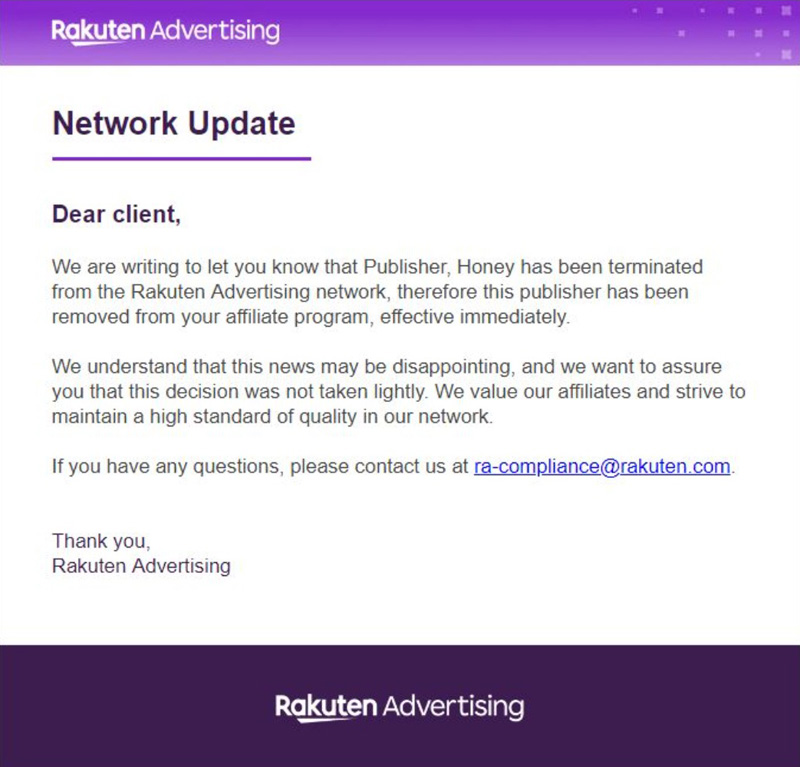
On Monday, January 12, Rakuten Advertising announced that Honey was “terminated from the network,” alluding to this termination as a step required “to maintain a high standard of quality” in the network:
On Friday, January 16, we learned that Honey was found to be “out of compliance” with impact.com’s “platform policies” and was “removed” from their “Discovery Marketplace”:

As the above image shows, though, impact.com’s is a temporary suspension, rather than a complete removal from the platform.
It is clear, however, that the grounds for both removals were noncompliance with network policies and engaging in behavior that undermines trust in the partnership economy, as impact.com’s CEO put it. The latter also explicitly called out “attribution manipulation” as the cause leading to PayPal Honey’s suspension.
Coincidentally, or not, the first of the two removals occurred on the first day of the largest U.S. affiliate conference, Affiliate Summit, which we attended as we do every year. “Rakuten” and “Honey” were certainly the words of the day that Monday: both at Affiliate Summit West and all over social media.
With the situation having so many interesting facets — from the perfect timing of the first suspension (excellent PR play, no doubt) to the well-overdue network-level tackling of conversion misattribution due to affiliate noncompliance — I want to look at this case as an affiliate manager.
Here, at AM Navigator, we believe that there are five important lessons to learn from this, and all of these should help people manage affiliate programs better.
1. One Bad Apple Spoils the Entire Program
No, not in the same way that one bad apple spoils the bunch. Normally, a good affiliate in the program does not get spoiled by a bad one (though we’ve seen cases where this does happen). The program largely suffers because many of the good affiliates that you want to work with won’t even bother partnering with you after seeing that you work with the players with whom they just can’t coexist.
Most present-day affiliate programs operate on the last-touch-wins-all rule. This means that the entire compensation for the conversion goes to the last affiliate who touched the converted customer.
Honey specifically got terminated for affiliate link hijacking and concealed violation of “stand-down” rules, which mandate that browser extensions “stand down” and not fire if there was another affiliate earlier in the clickstream. The reason? Not to overwrite the previous affiliate’s cookie, taking credit for the conversion.
Prior to joining your affiliate program, savvy, rule-abiding affiliates will check who else you’re partnered with. They will use the same policing tools that we, affiliate managers, use. In those programs where they see affiliates who are known for doing everything possible to drop the last cookie, they will often just not join (or won’t actively promote if they’ve already joined). One rule-violating affiliate always makes all other affiliates in your program suffer.
2. Do Your Own Policing. Don’t Rely on Networks
First off, make sure to spell out your affiliate rules in your affiliate program agreement or Terms and Conditions (Ts & Cs).
Secondly, understand that having the Ts & Cs in place won’t safeguard you from violations of these. However, while having these rules in place does not guarantee that affiliates will play by them, you now have the grounds to police and enforce affiliate compliance with them. Affiliates agree to play by your rules when applying to your program. Once you’ve approved them, you have the right to enforce the rules they’ve agreed to.
Thirdly, and finally, if you run your program on an affiliate network, do not count on the network’s compliance departments to do the policing for you. On the one hand, affiliate network compliance teams monitor for violations of a network’s rules and policies (not your program’s), and on the other hand, throughout my decades of managing affiliate programs, more than once have I seen networks look the other way.
It’s your brand and your business that is at stake here. So, make your own policing and enforcing a priority.
3. Take Time to Understand the Details
Honey was terminated/suspended “for the intentional stand-down violations and concealment,” but what are these, exactly, and do all browser extensions automatically do these? I’ve explained what “stand-down” means above, but there’s a lot more written about it online. The point I want to drive home is: when monitoring your affiliates’ activity, make sure you fully understand all the relevant intricacies and details. Only then will you be able to police in an intelligent way.
Speaking of Downloadable Software Publishers (DSPs), I recommend studying and bookmarking this excellent comparison by our friends at the Performance Marketing Association: Affiliate Network DSP Policies Comparison.
Additionally, a relevant study was recently performed by The Affiliate & Partner Marketing Association (APMA) in the UK. In essence, they carried out an independent audit of thirty brands across ten affiliate networks and three different affiliate types. APMA anonymized the data and outcomes but made the information available to networks and platforms in advance. They also covered a distinction between the different types of technologies in place (specifically, stand-down rules vs “soft click”). The resulting APMA study both demonstrated the complexity of this issue, and provided seven recommendations for industry. It doesn’t cost anything to get your copy of this 24-page audit here: Independent Audit of Attribution Rules in the UK Affiliate & Partner Marketing Industry.
As mentioned above, though, whatever network policies say, do not rely on networks for policing. Our experience shows that way too often, affiliate violations occur for much longer than it takes an affiliate network to take the violating affiliate down from the network. You don’t need to have them removed from/by the network to stop hurting your affiliate program, though. You can do it on your program level at any time.
4. Don’t Extrapolate and Don’t Generalize
Just as not all paid search affiliates engage in prohibited trademark bidding, neither do all browser extensions violate stand-down rules.
Over the many years of managing affiliate programs, I’ve seen multiple cases where whole classes (or types) of affiliates would be banned from the program. In some cases, loyalty affiliates would be put into the same bucket as coupon-oriented websites, and automatically declined from joining an affiliate program. In others, all browser extensions would be treated the same. In yet others, solutions for bringing rewards to closed user groups (e.g., Loyalize) would be equated to consumer-oriented cashback websites and treated the same.
Ultimately, it’s your affiliate program, and it’s up to you how to run it. Building on lesson #3, I urge you to pay attention to details, and evaluate every affiliate individually — without extrapolations or generalizations that often do a disservice to the ultimate development of affiliate programs.
5. Diversify Your Affiliate Base
Finally, and probably most importantly, if your affiliate program is seeing a substantial drop in affiliate-referred revenue after Honey is gone, you’ve been doing it all wrong. In my Successful Affiliate Programs Keep Failure in Mind article, among the final questions, I asked:
Are you committed to diversifying your affiliate base or are you putting all eggs in one basket, focusing only on one or two types of affiliates?
One of the most frequent problems that we observe while auditing affiliate programs is the all-eggs-in-one-basket situation. Not only are 80% or more of all affiliate-driven sales driven by a handful of affiliates, but 50% or more of these affiliates belong to the same affiliate type!
Over ten years ago, I suggested 18 types of affiliates to consider for each affiliate program. Today, I’d like to give you a more expanded list and suggest 28 affiliate types for you to explore while diversifying your affiliate base:
Affinity groups
Card-linked offers
Charities and fundraisers
Content producers
Complementary brands
Co-registration affiliates
Coupons and deals
Connected TV (CTV)
Consultants and service providers
Datafeed-driven websites
Domainers
Educators
Email marketers
Existing customers and brand advocates
Loyalty affiliates: both D2C websites and CUG (closed user group) solutions
Mass media opportunities
Mobile-oriented affiliates
Online communities and forums
Paid search affiliates
Pay-per-call publishers
Podcasters
Post-checkout solutions
Ranking and review sites
Retargeting and cart abandonment solutions
Social media influencers
Sub-affiliate networks
Software/extensions
Video marketers
For your convenience, the above checkboxes can be easily checked — so that you could then print the list out, and immediately see the affiliate types you’re still missing and need to go after.
If you need help in auditing your affiliate program (to identify any bad apples or other improvement opportunities) or diversifying through affiliate recruitment, we are here for you — just a phone call or a message away. Let’s build solid affiliate programs in 2026 and beyond!!
Great essay!
I agree with “do your own policing” in general, probably meaning hire someone. (Historically I did a lot of this kind of work.) I don’t know how well that would have worked out here. What Megalag and I found was very well hidden — in fact hiding was kind of the whole point.
I don’t think any other shopping plugin has ever been caught concealing its stand-down violations. Remember, Honey didn’t just fail to stand down. Honey tracked users (days since account created, number of points earned, and most of all cookies present) to determine who was a potential affiliate marketing professional and hence potential tester. I do think some other shopping plugins are cheating in ways not totally unlike what Honey was caught doing, but no one else has ever been caught the way we caught Honey — with videos, code review, telemetry, and config files.
Ben, thank you for chiming in.
First off, I appreciate your kind words on the essay. Means a lot coming from you. You know how much I respect the detective work you’ve been doing in affiliate marketing for the past two decades. Keep it up, fine Sir!
And yes, just as the whole affiliate marketing has become significantly more complex than what it was back in the days of FBI chasing Shawn Hogan and Brian Dunning, so have affiliate violators become much more difficult to catch, unless you use the right tools and/or experts. I always say that it’s impossible to catch a dayparting and geotargeting paid search violator by merely typing in your keywords wherever you are. You need tools for that. Same with the above situation. You need tools, experts, tactics. It is interesting to see what Honey was caught doing. Intricate play. Good job on catching it, and once again: keep up the good work!!